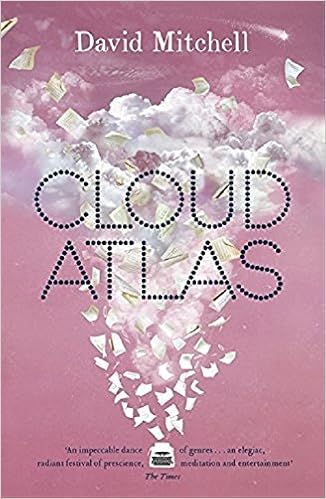
The Cloud Atlas follows the the story of 6 lives chronologically ordered across different time periods, stretching from the 19th Century to a post apocalyptic future. In an unusual narrative structure the first half of the book contains the first part of the first five stories. Then the fifth story is then told in full followed by the denouement in reverse order of remaining 5 until we get back to where we started.
The novel begins in the early 19th Century with diary of Adam Ewing who chronicles his journey through the South Pacific. The best historical fiction inspires you to learn more about the subject and this certainly does this. Ewings depiction of the Chatham Islands and Raiatea are fascinating, as is the story of intrigue that unfolds around him.
The follow up story is based on the letters of Robert Frobisher, a dashing victorian bisexual who struggles to square his outrageous behaviour with his own talent and ends up fleeing Britain to become the amanuensis of a retired and equally difficult composer. The voice that Mitchell manages to give Frobisher through his letter writing is masterful, Frobisher's difficult personality and unlimited ability to get into awkward situations is vividly portrayed in his letters.
For the third story there is another switch in both tone and style to a 1970s airport thriller told in the third person. Luisa Rey, an up and coming journalist, uncovers a conspiracy to suppress a damming report into the building of a nuclear power station. Like the previous story this is riveting stuff. Luisa's tale is told with thrills, action and pace that would on its own work its way to the top of any airport bestsellers list.
The action then moves to a contemporary setting in the form of a memoir of an elderly, irascible book seller, Timothy Cavendish, who finds himself imprisoned in a retirement home.
The final two parts occur in the future, again both wonderfully written. The first takes place in a dystopian future Korea where the corporations have taken over and create genetically modified clones and use them as slaves to do menial service jobs. The narrative is written in the style of the minutes of an with an investigator. The story is great however this was the only point in the novel where the method stretched believability. Some of answers seemed far to detailed to realistically have taken place in an interview.
The final segment is courageous story telling. Written in the style of an aural history it recounts the tale of a Hawaiian tribesman living on Big Island in a post apocalyptic far future when civilisation has collapsed. This is perhaps the most difficult section of the book, written in dialect similar to Hawaiian Pidgin it is a challenging and rewarding read. This will inevitably put some readers off, which is a shame as once you get into the swing of it the story itself is very good, and of course giving up here means that you miss out on the finales of the other 5 stories.
Putting the expert story telling aside the structure of the novel is somewhat gimmicky and this is where I have a major gripe. By the time you arrive at the second part of some of the first stories you read, you are long way both in terms of time and the sheer amount of plot, from when you read the first part. So long in fact, that it becomes difficult to remember the detail of what happened in previous chapters and have to start flicking back to part one to remember who the characters are.
What makes this infuriating is the lack of a coherent thread linking the storied together. There are themes that stretch through the book, but unless you're a fan re-incarnation these threads seem very tenuous indeed. This lack of coherency then renders the unusual gimmicky structure pointless, and in fact presents an obstacle to the full enjoyment of the novel. Which is a shame because on their own each of the stories is a masterclass in story-telling and a remarkable feat of writing.
However what isn't gimmicky is the standard of the writing. The diversity of the incorporated styles was an ambitious task and one that David Mitchell pulls off with great precision. A lot of writers couldn't write a single story as good as each of the five to be found in this novel but Mitchell manages to switch between voices with an authenticity that is as impressive as it is bewildering.
The novel begins in the early 19th Century with diary of Adam Ewing who chronicles his journey through the South Pacific. The best historical fiction inspires you to learn more about the subject and this certainly does this. Ewings depiction of the Chatham Islands and Raiatea are fascinating, as is the story of intrigue that unfolds around him.
The follow up story is based on the letters of Robert Frobisher, a dashing victorian bisexual who struggles to square his outrageous behaviour with his own talent and ends up fleeing Britain to become the amanuensis of a retired and equally difficult composer. The voice that Mitchell manages to give Frobisher through his letter writing is masterful, Frobisher's difficult personality and unlimited ability to get into awkward situations is vividly portrayed in his letters.
For the third story there is another switch in both tone and style to a 1970s airport thriller told in the third person. Luisa Rey, an up and coming journalist, uncovers a conspiracy to suppress a damming report into the building of a nuclear power station. Like the previous story this is riveting stuff. Luisa's tale is told with thrills, action and pace that would on its own work its way to the top of any airport bestsellers list.
The action then moves to a contemporary setting in the form of a memoir of an elderly, irascible book seller, Timothy Cavendish, who finds himself imprisoned in a retirement home.
The final two parts occur in the future, again both wonderfully written. The first takes place in a dystopian future Korea where the corporations have taken over and create genetically modified clones and use them as slaves to do menial service jobs. The narrative is written in the style of the minutes of an with an investigator. The story is great however this was the only point in the novel where the method stretched believability. Some of answers seemed far to detailed to realistically have taken place in an interview.
The final segment is courageous story telling. Written in the style of an aural history it recounts the tale of a Hawaiian tribesman living on Big Island in a post apocalyptic far future when civilisation has collapsed. This is perhaps the most difficult section of the book, written in dialect similar to Hawaiian Pidgin it is a challenging and rewarding read. This will inevitably put some readers off, which is a shame as once you get into the swing of it the story itself is very good, and of course giving up here means that you miss out on the finales of the other 5 stories.
Putting the expert story telling aside the structure of the novel is somewhat gimmicky and this is where I have a major gripe. By the time you arrive at the second part of some of the first stories you read, you are long way both in terms of time and the sheer amount of plot, from when you read the first part. So long in fact, that it becomes difficult to remember the detail of what happened in previous chapters and have to start flicking back to part one to remember who the characters are.
What makes this infuriating is the lack of a coherent thread linking the storied together. There are themes that stretch through the book, but unless you're a fan re-incarnation these threads seem very tenuous indeed. This lack of coherency then renders the unusual gimmicky structure pointless, and in fact presents an obstacle to the full enjoyment of the novel. Which is a shame because on their own each of the stories is a masterclass in story-telling and a remarkable feat of writing.
However what isn't gimmicky is the standard of the writing. The diversity of the incorporated styles was an ambitious task and one that David Mitchell pulls off with great precision. A lot of writers couldn't write a single story as good as each of the five to be found in this novel but Mitchell manages to switch between voices with an authenticity that is as impressive as it is bewildering.
Comments